

Hearing and how we hear
The human ear comprises the:
OUTER EAR,
the MIDDLE EAR
and the INNER EAR.
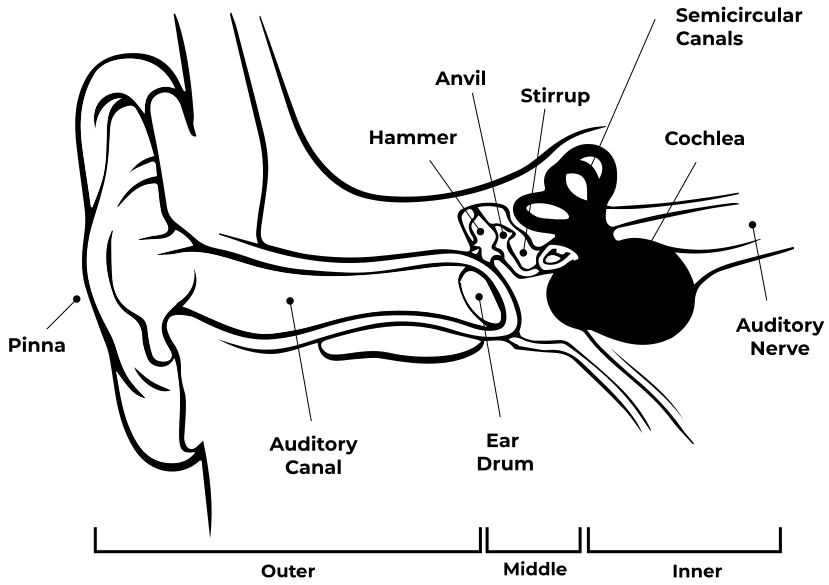
The OUTER EARS function is to collect sound waves (which are actually nothing more than airborne vibration) in the bowl of the ear, amplify them at key frequencies which are important for hearing speech (a bit like a built-in ear trumpet – hence the shape) and direct them into the ear canal (which amplifies them again) down to the eardrum which then starts to vibrate.
The term MIDDLE EAR refers to a pressurised chamber inside your skull directly behind your eardrum. The three smallest bones in the human body live there – the Hammer or Malleus, the Anvil or Incus and Stirrup or Stapes. The Hammer is connected to the eardrum and the Stirrup to the inner ear. Collectively they are the Ossicles and their purpose is to act as a kind of crowbar to further increase the amount of energy delivered to the inner ear.
The INNER EAR houses the Cochlea which is a pea sized organ consisting of two liquid filled galleries which are reactive to movement from the Ossicles. When the Ossicles move in response to a vibration there is an increase in pressure in the upper gallery. This sets up a wave in the liquid, which presses down on the lower gallery. Via some complex anatomy and thousands of hair cells the movement generates coded electrical signals to the brain which then travel up the AUDITORY PATHWAY to the brain where the vibration is perceived as sound. It is a model of elegant evolution being sufficiently acoustically pure to potentially enable us to:
- Detect small changes in volume
- Detect small changes in pitch – the range of the average ear is 20 – 20,000Hz
- Determine where a sound has come from – both horizontally and vertically
- Detect speech in noise
- Detect danger
Hearing from a subjective point of view
What has just been described is a much-simplified account of the mechanics involved in physically receiving a signal. What a person hears day to day also depends on what the brain does with the signal it receives, auditory memory, how much practice the listener gets and the level of interest at that moment in time. It also, of course, depends on how much of the signal is received.
Measuring hearing
Hearing is an entirely subjective matter which is measured and recorded using objective means. The only way to give this measurement some relevance is to compare it to a useful average. Level 0 dB (HL) on an audiogram is that useful average – 0 dB (HL) is NOT “no sound” but the quietest average sound a group of 1500 Twenty-One-year olds heard when tested in the same way some time ago. Some individuals hear better than a group average hence the -5 and -10 dB (HL) levels. 0dB (HL) therefore represents extremely good hearing since generally we are in peak physical condition at that age.
The person being tested wears a set of headphones and we play a series of sounds which are all important as far as hearing speech is concerned (speech typically takes place between 250Hz – 8,000Hz) and record the quietest sound the subject can hear for each of the sounds that are played. This is done separately for each ear and results in an audiogram such as the example shown on the right.
Air & Bone Conduction Testing
The circles joined by the red line represent the Air Conduction pattern for the right ear and the crosses joined by the blue line represent the Air Conduction for the left ear. In other words, the sound has been delivered via a set of headphones over the ear through the air, into the persons OUTER EAR, on into the MIDDLE EAR and finally to the INNER EAR.
Hearing professionals carry out another test called Bone Conduction testing whereby a vibrator is placed on the mastoid bone at the back of the ear and some of the sounds are replayed. This bypasses the OUTER EAR and MIDDLE EAR mechanisms and stimulates the INNER EAR direct. The results are recorded with green triangles.
Hearing loss
A clinically mild loss is broadly one where the readings fall between 20 and 45 dB (HL).
A clinically moderate loss is one where the readings fall between 45 and 65 dB (HL).
A clinically severe loss is broadly one where all the readings are above 65dB (HL)
Once a person requires more than 90dB (HL) of sound played straight into their ear in a quiet room before they can detect the sound, they are said to have a profound loss.
Very few people have a hearing pattern which falls directly into one of the above categories. Most people hear some sounds better than others which often serves to deceive and, because they seek help at different stages of the loss time wise, can be experiencing markedly different consequences of that loss.
Putting an audiogram into perspective – real examples
The following provides an approximate typical reading for everyday sounds to put the audiogram into perspective:
| 0dB = | Threshold of hearing |
| 30dB = | Bedroom at night |
| 60dB = | Typical speech |
| 90dB = | DIY handheld drill |
| 120dB = | Jet aircraft at 100 metres |
| 140dB = | Threshold of pain |
Even with something this apparently straightforward there are perceptual differences. A clock ticking in the middle of the night when everything is quiet sounds distinctly louder than it does during the day. Noise in pubs/ restaurants (if your hearing is good) can seem very loud when you go in yet settle down as you get used to it. The converse is true if your hearing is not so good.

Do you work in heavy industry?